|
|
 Pachadi and Kichadi are the prominent ones in “thodu –curry” section, giving a colorful start to ‘the organic plate’. They are usually cooked with various vegetables in ground coconut and homemade curd base, giving a taste of freshness. I do not know the theoretical difference between pachadi and kichadi but based on my personal experience, as the princess daughter of the Queen of Arabian sea, pachadi is where vegetables are cooked in little water and then ground coconut flavored with pounded mustard seeds, is added and finished with home-made curd and seasoned with coconut oil and curry leaves where as Kichadi is vegetables fried in oil and then enhanced with a touch of fresh curd. If anyone out there knows the correct differentiation, please enlighten me.
Amongst the predominant yellow, white and brown curries of Sadya, this pretty princess reigns as the queen of colors in ‘the organic plate’. Finely chopped beetroot pieces are cooked in water, mildly spiced with green chillies and pungent taste of ginger, and then cooked in fresh ground coconut and homemade curd base and finished with the wonderful aroma of curry leaves and coconut oil.
Ingredients: - (Approx.)
- 1 cup beetroot, finely chopped
- 2 green chillies
- A small piece of ginger, finely chopped
- A pinch of turmeric
- Salt to taste
- 2-3 tbsp water
For Grinding:-
- ¼ cup grated coconut
- 2 green chillies
- 2 pinches of mustard seeds
- Salt to taste
¼ cup beaten curd
For seasoning:
- 2 tsp oil, preferably coconut oil
- ¼ tsp mustard seeds
- 1-2 whole dry red chillies
- 5-6 curry leaves
Directions:
- Grind grated coconut and green chillies into a smooth paste, in the small jar of a mixer or blender, adding some water if required; add mustard seeds at the last minute and grind it along with coconut and keep aside.
- In a small saucepan, cook the chopped beetroot pieces with green chillies, ginger, turmeric powder and salt, adding 2-3 tbsp water, just enough to cook the vegetable. When beetroot turn soft, add the ground coconut mixture and cook again, in low-medium heat, till it starts to boil. Add the curd and adjust the salt; mix everything well and turn off the stove (before it starts to boil) not letting the curd to boil. At this stage, the curry should have a medium consistency, neither thick nor thin or dry.
- In another pan, heat oil and splutter mustard seeds, dry red chillies and turn off the stove and immediately add the torn curry leaves and pour the whole thing to the dish; Close the lid and let it rest for sometime before serving.
Luv
Shn
|
No part of the content ( articles, photographs, recipes) of this blog may be reproduced without my written permission.Copyright © 2007-2010 Kitchenmishmash.blogspot.com. All rights reserved.
|
 Pachadi and Kichadi are the prominent ones in “thodu –curry” section, giving a colorful start to ‘the organic plate’. They are usually cooked with various vegetables in ground coconut and homemade curd base, giving a taste of freshness. I do not know the theoretical difference between pachadi and kichadi but based on my personal experience, as the princess daughter of the Queen of Arabian sea, pachadi is where vegetables are cooked in little water and then ground coconut flavored with pounded mustard seeds, is added and finished with home-made curd and seasoned with coconut oil and curry leaves where as Kichadi is vegetables fried in oil and then enhanced with a touch of fresh curd. If anyone out there knows the correct differentiation, please enlighten me.
My mother usually resorts to pavakka kichadi where bitter gourd is fried in oil and finished with a touch of curd. Since CJJ is quite fond of Ulli Kichadi, I usually go for this one whenever I prepare the traditional feast and this recipe is from my friend, R who introduced us to this dish in one of the Onam celebrations in Uncle Tom’s land.
Ingredients: - (Approx.) - 1 cup big onion, minced
- 2-3 green chillies, minced
- 1 inch piece of ginger, minced
- Around ¼ cup oil to fry
- 1 ¼- 1 ½ cup curd
- Salt to taste
Directions: - Heat oil in a shallow pan and fry the green chillies and ginger till it starts to brown and keep aside. Fry minced onion till it reaches golden brown and keep aside.
- Mildly beat the curd and add the fried onions, ginger and green chillies to the curd and blend well. Add salt if needed and serve.
LuvShn
|
No part of the content ( articles, photographs, recipes) of this blog may be reproduced without my written permission.Copyright © 2007-2010 Kitchenmishmash.blogspot.com. All rights reserved.
|
 A perfectly balanced condiment, where in fresh ginger is fried and cooked in the sourness of tamarind and sweetness of jaggery and spiced up with the pungent taste of ginger itself. Another indispensable item on the extreme left of “thooshan ela”, the narrow and curved part of plantain/banana , this dish takes time to cook and thicken to its right consistency. My grandma’s version is the tastiest preparation I have ever tasted in my life. Though my mother follows the same recipe, which she has passed on to me, both of us have never been successful in bringing that right balance of sweetness and sourness , my grandma used to achieve in her preparation. The taste and aroma of her puli inji still lingers in my mouth…….another one of my sunken treasures…… Ingredients: - (Approx.)
- ½ cup minced fresh ginger, tightly packed
- 3-4 Indian green chillies, finely chopped
- 4-5 curry leaves, finely chopped
- ½ tsp mustard seeds
- ¼ tsp fenugreek seeds/Uluva
- ¼ tsp Uzhunnu parippu/urad dal/black gram
- 2 whole dry red chillies
- 3 tbsp coconut oil
- 1 ½ cups water
- 3-4 jaggery/sarkkara cylinders, with 1 ¼ inch length and ¾ inch width OR to taste
- 2-3 tsp tamarind concentrate OR to taste
- ¼ tsp chilly powder
- ¼ tsp turmeric powder
- Salt to taste
Directions: - - In a small deep saucepan or stone vessel, heat water, tamarind paste, melt jaggery with red chilly powder, turmeric powder and salt and bring to a boil and then keep the lid open and place a stirring utensil in it and let it simmer until it reaches half the quantity of the water. Adjust the tamarind-jaggery balance by doing a taste-test here and adding the extra bit if necessary. There should be a proper balance between tamarind and jaggery. So adjust according to your personal taste.
- Meanwhile, heat oil in a shallow pan and splutter mustard seeds, fenugreek seeds, urad dal and dry red chillies. Add minced ginger, green chillies and curry leaves and fry until ginger turns golden brown, in low flame. Enjoy the wonderful aroma coming off the pan at this point. Using a slotted spoon, transfer all the ingredients from the pan, including the oil (there will not be much oil left), to the saucepan where the tamarind and jaggery mixture is simmering. Once more bring to a boil and then reduce the heat to low flame and let it thicken until the oil layers floats on top. At this stage, turn off the stove. It thickens more when it sits in the room temperature.
- This can be made in advance and stored in refrigerator for a long time. The oil floating acts as a preservative here. It can be served not only at Sadya but also a great condiment for Biryani
Luv
Shn
|
No part of the content ( articles, photographs, recipes) of this blog may be reproduced without my written permission.Copyright © 2007-2010 Kitchenmishmash.blogspot.com. All rights reserved.
|

Achaar is a spicy condiment served on the extreme left of “thooshan ela”, the narrow and curved part of plantain/banana leaf, to be eaten in small quantities, with the touch of index or middle finger…..perhaps the only spicy item on ‘the organic plate’. It is usually pickled vegetables or fruits, cooked and preserved in gingelly/sesame oil and vinegar, spiced up with loads of chilly powder and flavored with asafoetida, fenugreek, curry leaves and salt. Sadya varieties include manga /mango achaar, and lemon/lime varieties like naaranga achaar, vaduka-puliyan achaar etc. This can be made in advance and stored in an airtight container. Manga Achaar or spicy mango pickle is one of the easiest and less messy ones to make and this is my mother’s recipe:
Ingredients: (Approx.)
- 1 medium size raw-green mango
- 4-6 medium garlic cloves, thinly sliced
- 1 tbsp ginger, thinly sliced
- 1 sprig of curry leaves
- 3 tbsp red chilly powder
- 2 pinches of asafoetida
- ¼ - ½ tsp fenugreek/Uluva powder
- 2 ½ tsp vinegar
- 1/3 cup gingelly oil/Nallenna
- Salt to taste
Directions: - Sterilize an airtight glass jar to store the pickle.
- Peel off the skins and chop the mango into small pieces
- Heat oil in a pan, and fry the garlic slices, in low heat and remove when they turn golden brown; fry the ginger slices and remove and keep aside when it reaches golden brown; add the chopped mango pieces, salt and curry leaves, warm them up in hot oil and when it is fully coated in oil, remove and keep aside. (Note: DO NOT cook mangoes in the oil for more than few seconds. Now either turn off the stove or take the pan from the stove and add chilly powder; the purpose is not to burn the chilly powder while adding them. Also add asafoetida and fenugreek powder and stir well; bring the pan back to the stove and add the mangoes along with roasted garlic and ginger. As a final step, add the vinegar and salt and stir well and turn off the stove.
- When it cools down, transfer it to the sterilized and airtight glass jar; can store it in refrigerator or leave it on the counter top.
Luv
Shn
|
No part of the content ( articles, photographs, recipes) of this blog may be reproduced without my written permission.Copyright © 2007-2010 Kitchenmishmash.blogspot.com. All rights reserved.
|
 Pappadam, Pazham & upperis (Plantain chips) are the first few entries, generally served on the extreme left of the “Thooshan ela”, narrow curved part of plantain/banana leaf. Plantain chips are the signature crispy treats from Kerala and if you travel across the state, you will come across many small specialized shops selling these crispy treats, especially at the main bus stands and junctions. Nenthrakkula ,hanging on ropes in front of such shops and a “lungi-clad” guy with a cotton towel on his shoulder, effortlessly slicing off plantains, using a mandolin, into a big ‘uruli’ , (a wide-mouthed bell metal vessel) filled with hot oil and the sizzling sound when he pours salt water to flavour the sliced bananas, frying up in oil………ohh how I wish I could get a fresh batch of fried chips!!!!!!
I resort to making nenthrakkaaya upperi only when I want to make a traditional feast and serve everything cooked right from scratch. Hence, I usually use only one plantain and here’s how I go about it. Make 4 slits on the plantain and remove the skins. Rub off the surface with a fresh new piece of scrub or back home, my mother uses “chakiri”, the fiber from the husk of the coconut and smoothens giving it a nice glaze. In a deep bowl, fill some water and add ½ tsp turmeric and salt and soak unripe bananas in it for about 20 minutes. After that dry it thoroughly with a kitchen napkin and slice it off very thinly, using a mandoline. Keep the sliced ones on a wax paper. In another small bowl, take ¼ cup water and mix with some ½ tsp salt and keep aside. For one plantain, heat about half cup of coconut oil and when it is hot, add the sliced pieces to hot oil in small batches and fry for few minutes. Using a slotted spoon, adjust the traffic among the frying chips. When the chips are half done, drizzle some salt water to it, keeping one arm distance from the stove as it disturbs hot oil and splashes a bit. When the bubbles settle down, wait for some more time, until the chips beginning to look crispy and at this point, transfer them, using a slotted spoon, to a tray lined with tissues/napkins to absorb the excess oil on the chips. If it is your first time, start with a very small batch and then improvise with the next batches. It all depends on the temperature of the oil. Store it in airtight container only when it is completely cool. I have learnt from my experiences that the slicing should be even to get everything crispy. Also we need to wait till it completely cools before storing it in containers. There is one more variety of plantain chips called Sarakkavaratti or Sarkkara Upperi which is thick plantain quarters fried in oil, then coated with jaggery syrup, with a dash of powdered dry ginger, cumin and cardamom. I am yet to master this preparation and hence please check out RP’s version. Sadya is unimaginable without Pappadam…..a crispy fried flat-bread, made of black gram flour……it is crushed with Sambar along with rice or crushed with Payasam/Pradhaman (desserts) or sometimes a “time-pass bite”, along with banana chips or Sarkkaravaratti when one waits for all the items to be served on the banana/plantain leaf. Unlike other Indian wafers, falling into the same category, Kerala Pappadams puffs up so well. In, Kerala, Pappadams are usually deep fried in oil. When oil is hot enough, slide one round Pappadam into the hot oil and deep -fry for 3-4 seconds, until it is crisp and puffed up. Health conscious group can microwave, instead of deep frying. It takes about 1 minute in microwave. Since Kerala Pappadams were/are not available in the area where I reside, the one shown in the picture is Chennai Appalam and not Kerala Pappadam. Will update once I have access to some! Pazham/banana is another unavoidable item in Sadya. Preferred varieties are Poovan pazham, cheru-pazham, Paalayan-kodan pazham and kadhali pazham and I am partial to Poovam Pazham and cheru-pazham :) One can wrap –up the feast by having a fresh fruit after the dessert or the more traditional, tasty way of enjoying the fruit which is a bit clumsy, to some, is by squishing the banana and crushing the Pappadam onto the hot Payasam/Pradhaman (desserts), on the banana leaf and taking a scoop with your fingers, then right on to your mouth and finish the whole ecstasy with a touch of manga achar or puli inji :D I see some doing “Ewww……” and some saying “Slurrppppppp……” :) :)
Luv
Shn
|
No part of the content ( articles, photographs, recipes) of this blog may be reproduced without my written permission.Copyright © 2007-2010 Kitchenmishmash.blogspot.com. All rights reserved.
|
 Been enjoying this finger food for a long time now….but never knew the right name……never bothered to find out as well! N , a very good friend of mine and her mother introduced me to this combo during one of the group-study sessions at her place…..three of us got together to study statistics and economics, two boring and tough subjects for me and if you ask me to refresh my memory of that particular day, I don’t even remember what we studied……not even the topic of the study but all I can think of is the yummy spread her mother prepared for us……… and the Karimeen Varuthathu/Fried Pearl spot, prepared just for me when aunty found out that it was one of my favourites………a gesture that touched me a lot…….and then this deadly combo…..dont know how many I had that day……whenever I made this , it was a great hit with everyone……so thought of sharing it with you all….but when I sat down to make this post, I was not able to think of a fancy name for it…….sort of in a brain freeze as too many things are happening at my end……we re in the middle of a relocation………shifting to a new place and home here in US itself……I will be traveling for the next two weeks and once we find an apartment and settle at the new place, I hope to resume blogging…till then I will be on a short break………….with so many drafted recipes and photographs in the dashboard, I wont be gone for a long time….so trust me, I will be back soon :). Since all I can think of is how to transport my ‘curry-chatti’ and terracotta decors in one shape and plants alive, I leave the challenge to you friends, to find an apt name for this trio :)
Well, coming to this delicacy in picture, it is a deadly combination of small bite size pineapple chunks, cream cheese and glace cherries on a toothpick/skewer. This can be served as a pre-appetizer or a quick and simple dessert; pairs well with champagnes and wines too which means it is great for cocktail parties too. I am not sure about the availability of cream cheese back home in India but I am certain that Amul cheese squares works well with this as I used to buy that for preparing this one.
Try this and name the trio too :)
Hope to be back soon…..till then you take care and eat well :D
Luv
Shn
|
No part of the content ( articles, photographs, recipes) of this blog may be reproduced without my written permission.Copyright © 2007-2010 Kitchenmishmash.blogspot.com. All rights reserved.
|
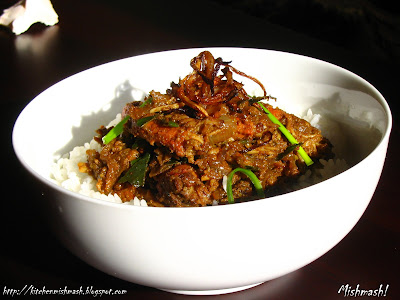  I disclosed one of my deepest fears in public four or five weeks back, remember…? My fear for the crawling beauties! And this was the first crab dish I tried, to conquer the fear of handling crabs and I started out on a safer track, by buying some cooked King crab legs from one of the best seafood stores in town and to my surprise, there was this abundance of seafood flavour and taste, though I always had a biased perspective on buying cooked or frozen seafood meat from the stores. Remember one of the first charming scenes in ‘Ratatouille’ where Remy, the delightful rat tells his brother Emile about the art of “blending flavors and spices”? While drafting this post, somehow this scene flashed in my mind leaving a smile on my face and now while I am at it, I guess it’s quite appropriate for this particular recipe where the spices really come to embrace the seafood flavor in all its vigor. This is again my mother’s recipe, quite a juicy, spicy one to tickle and dance on your palate. As CJJ puts it, it’s quite an “explosion of flavours “ :)Before I move on to the recipe, let me note that I first bought the cooked King Crab legs, weighing around 1 lb , inclusive of its shells and then took out all the meat chunks from the shell, which filled around 1 ½ cups. This might vary for each purchase, depending on the size of the crab legs, and hence, please adjust the spices and proportions accordingly.  Ingredients: (Approx.) - Around 1 ½ cups cooked crab meat chunks ( I used meat of cooked King Crab legs)
- 1 small size big onion, thinly sliced
- ½ cup small red-pearl onions/shallots thinly sliced
- 4 green chillies, finely chopped
- ¾ tsp ginger, finely chopped
- ¾ tsp garlic, finely chopped
- 2 sprigs curry leaves
- 2 tbsp coriander powder
- ½ tsp chilly powder
- ¼ tsp turmeric powder
- Masala powder (Recipe follows)
- Salt to taste
- ¼ - ½ cup water
- 2 tbsp oil, preferably coconut oil
For the Masala Powder:- 1 ½ tsp fennel seeds
- 1 tsp whole peppercorns
- 1 clove
- 1 cinnamon
Directions:- Make the masala powder by grinding fennel seeds, peppercorns, clove and cinnamon into a fine powder, in the small jar of a mixer or coffee grinder. Keep ¼ tsp aside before adding the masala powder to the dish.
- Heat oil in a pan and sauté thinly sliced big onion and small onions till they turn soft; now add finely chopped ginger, garlic, green chillies and 1 sprig of curry leaves and stir till everything turns soft and golden in color. Now add turmeric powder, coriander powder, chilly powder and the freshly ground masala powder and sauté for a minute, in low heat or till the raw smell goes. At this stage, add the cooked crab meat and gently stir to coat all the masala to the meat. Add ¼ to ½ cup water to this and let it cook covered for few minutes, in low heat. When the gravy is thick and masala is well blended with the crab meat, adjust the salt; add ¼ tsp masala powder, kept aside earlier and crush some curry leaves in coconut oil and add the same to the dish; these two last minute touches give a wonderful aroma to the dish.
- Serve warm with rice or chappathi(Indian flat bread) or palappam (Kerala’s laced pancakes). You may garnish with some caramelized onions (deep fried brown colored onions with a pinch of salt or sugar) as well.
LuvShn
|
No part of the content ( articles, photographs, recipes) of this blog may be reproduced without my written permission.Copyright © 2007-2010 Kitchenmishmash.blogspot.com. All rights reserved.
|
|
|
|
|


 All text and Photographs are copyright protected.
Copyright © 2007-2010
Kitchenmishmash.blogspot.com. All rights reserved.