|
|
 A simple unpretentious drink by description yet the moment you gulp down that first sip the suspicious glance hidden at the corner of the eyes earlier, turns into one of a pleasant surprise followed by nodding of head in agreement. And if such a down to earth blend is accompanied with some vivid tales and imagery from the past, that’s a recipe to win your hearts. Such recipes come with a soul and character of its own.
Here’s one such treasure that came in my mailbox last Monday. I let you all have a glance at some parts of that mail where the daughter, Prathibha captures her dad’s tales from the past in a very engaging mail which took me to a bygone era I ve watched only in movies. Let’s extend a warm welcome for this dad-daughter duo.
Hi Shn, Long time since I mailed you. How have you been? Warning : Long Mail!! Read when you have time :)
I just checked your blog and saw the kinnathappam post. Used to love it when achamma used to make it. But hate the one you get in bakeries these days, esply that raw taste. Did you know bakeries used to be called appakoodu? Dad tells me people rarely used to buy stuff from appakoodu and usually snacks are made at home in bulk. Dad's younger bro used to clean up all kinnathapam kept at home and when guests come, it will be just the dabba which they keep snacks. And achamma used to make achan run to the appakoodu to get snacks.
Since you have been collecting long-lost recipes, I thought I will send you this one. Chakkara-Vellam(water). According to my dad, this drink used to be popular in his youth. If I quote him "eppozhokkeya ee pilleru oru koopiyum thurannu thanniyadichirikkunne, pandokke, aval kozhachathum chakkara vellavumayirunnu. Kaikku nalla bhalamulla oruthan aval kozhakkum. Innathe pole machine-il idicha aval alla.. atha kozhakkan menakkeda..." He fondly remembers the time when people used to gather around/below some bridge in Kannur and have aval and chakkara-vellam.
I tried this out and so thought will send you the recipe.
By Chakkara , it means karipetti or pananchakkara (and not sharkkara). They used to be wrapped up in coconut/palm leaves made into a kotta. We get Karipetti here, small blocks of it. ……………..
Chop 2 shallots finely. Add a small block of mashed karipetti to it and mix with water. Salt is optional. It can be used instead of moru-vellam. I am attaching the pics, they dont look all that great and shallot pieces look quite big in it. Frankly, it took a moment to adjust to the taste. But I liked biting into the kutty shallot peices when you drink it. It is different from all the other drinks I have tasted. So I'd recommend you try it out once. After all, there is absolutely no effort in making it. ……………
Dad has a background story for it also.
Pandokke aalkaar marichal, relatives-ne okke ariyikkaan othiri dooram nadannu ponam. So the neighbours and friends start out to different directions immediately after the death is announced. They might have to walk for hours or sometimes days(Talking about the days when even telegram was pretty rare). This drink is simple that it can be made easily and the karipetti gives a lot of energy they need to walk. The neighbours only do every arrangement for the funerals including cutting the trees(esply maavu) and chopping it up into logs. So on the 16th day after death, the family of the deceased give food/sadhya to the neighbours and others who helped out in order to thank them for helping. Though these days the same tradition goes on of giving feast on 16th or 48th day after the death. .............................. ............
Take care Prathibha
“He fondly remembers the time when people used to gather around/below some bridge in Kannur and have aval and chakkara-vellam”. Well, reading that line, I was tempted to give it a try and I did. I must admit, it is a lovely pair. Considering the fact that both Aval Nanachathu and Chakkara Vellam do not require any cooking, I could very well see her dad’s point of having it not only as a simple snack and drink but also as an energy drink to those people who walked miles and hours together to pass the message to the relatives of the deceased.
Prathibha has asked to mix finely chopped shallots/small pearl onions/Kunjulli and crushed Karipetti or Panamchakkara ( a variety of palm sugar), with water and written that adding salt is optional. But I added salt and noticed that it brings out the distinct flavours of palm sugar very prominently. I didn’t have Karipetti or Panamchakkara at home, but had a block of Thenginchakkara which is similar but made from the sap of coconut palm, I guess. While sipping it , I was having a strange thought it could very well be converted to an exotic mocktail/refreshing drink if you serve it chilled in a stylish martini glass and baptize with a fashionable catchy name!! :)
Prathibha , Thanks a ton for sharing such an interesting read and also letting me publish it here. Hope you and your dad will have more tales and recipes of the past, to share with all of us. I extend my whole-hearted gratefulness to both of you :)
Related Posts: 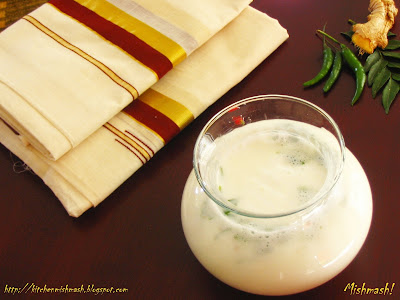      Luv Shn
|
No part of the content ( articles, photographs, recipes) of this blog may be reproduced without my written permission.Copyright © 2007-2010 Kitchenmishmash.blogspot.com. All rights reserved.
|
 Food evokes memories ………the smell wafting though the air and flavours lingering on the palate is powerful enough to glide us through the long forgotten days of childhood and in my case, sometimes even a mere mention of a particular food, takes me back to those days that has begun to fade away from my little brain. That is exactly what happened when Mathew wrote “ uppu itta kanjivellam is a favourite drink of mine..:-)”, as part of his comment for my post on Kanji Pidi. While reading that comment, I did not have the slightest clue that I would end up writing a post on Kanjivellam which is nothing but the rice stock you get while cooking rice. When I read that comment, my first reaction was “ewww…” as I always associated it with those days when I was down with fever and vomiting……. I remember my mother giving me a glass of the same and asking me to take small gulps every now and then, after a series of my throwing up into that red plastic bucket, kept near the cot!! I remember my father massaging my hands and legs and me swallowing it like some poison as it was unbelievably bland and my requests for flavoring it with some ghee or pickle was denied ruthlessly because of high temperature and stomach upset!! Kanjivellam flavored with a dash of salt was our indigenous home remedy to cure stomach upsets, prevent dehydration of the body and regain physical strength. Though I got absorbed in my daily routine, at the back of my mind this thread linking back to my memory lane, was going on in a loop. As the habit goes, knowingly or unknowingly I started plowing through my memory fields which opened up a deluge of images that came flashing back to my mind. I saw our maid, Omakutti Chechi, asking my mother for that hot kanjivellam, just drained from the Kanjikalam, rice cooker before she left for my uncle’s house….it was a sort of energy drink for her. It was the same case with the worker Chothi, whom my father appointed every year to clean up our yard after the monsoons……..a hot bowl of Kanjivellam fetched him energy to dig the yard with a shovel for a couple of hours. At this juncture of my thoughts, I shared what was going on in my head with CJJ and I saw his face lit up with a smile at the mere mention of “ uppitta kanjivellam” aka salted rice stock and he added how the field workers in their estate knocked at the back door of their kitchen asking, “ Chechee…..kurachu kanji vellam kitto…?“ meaning, “ Ma’m …can we get some rice stock? " !!!! That’s when it struck me how this humble ordinary homely drink is woven into the lives of a Malayalee …..and I knew it was time for me to bring Kanjivellam into the limelight :) Kanjivellam is not just an energy drink or a simple home remedy, it turns out to be our traditional alternative to modern shampoos. Yes, it was also used for hair care!!! I remember, in my early childhood, before I gained the courage to buy that blue bottle of Clinic Plus Shampoo, our hair wash on weekends included ceremonious soaking of a crushed and dried variety of herb called, ‘ enja’ in Kanjivellam and later mixed with another leafy herb called, ‘ vellilathaali’ as an organic alternative to shampoo. My maternal grandmother soaked ‘ Pappadam’, Kerala wafers in ‘ Kanjivellam’ to wash her hair.....it was used to make the hair more stronger and shinier... So I would call this as Kerala’s ‘organic shampoo’ :) This is again Kerala’s indigenous yet clever discovery for wrinkle –free cotton ‘ Mundu’ before spray starch and powdered starch made its entry into the market. Washed clothes got a quick drench in Kanjivellam diluted with water and then hung on ropes to sun-dry and later ironed to get wrinkle free clothes and a crisp finish! This might sound strange to some but if you go to a small town or village in Kerala, you will see men using Kanjivellam for mixing ‘ Pinnakku’, a type of cattle food to feed cows…..I remember my uncle doing the same before milking the cow every morning when I was there to collect cow's milk, just up from slumber, with puffy eyes and hair standing in the air like that of Fido-Dido of 7Up!! You might also come across people using one-day-old ‘ Kanjivellam’ as a plant food for Plantain or banana trees! So that was ‘ Kanjivellam’ playing the role of organic energy drink, home remedy, hair care, laundry starch, cattle food and plant food! :) If you find this whole post silly, blame it on Mathew…he is the one who fired up my dead memory cells :) On a serious note, Thanks pal…..you did help me recollect some of the images I haven’t thought about in almost a decade! Moral of the story – be careful while leaving comments in this blog, consequences can be as dangerous as this post :) Luv Shn
|
No part of the content ( articles, photographs, recipes) of this blog may be reproduced without my written permission.Copyright © 2007-2010 Kitchenmishmash.blogspot.com. All rights reserved.
|
This post is part of SADYA VIBHAVANGAL – Learn to make the traditional Kerala Feast- An Artist’s Edible Palette !
Kerala’s classic Dhaahashamani, thirst quencher in its true sense……..A refreshing summer drink and on a side note, Sambaram is also given when someone is sloshed or hammered :). Even before lemon juice and Rasna and aerated drinks grabbed its current place, Sambaram was served to guests. It was and is the most preferred drink of the worker class who spends most of their day under the scorching sun as it helps to cool down the body. Sambaram/Morum-vellam/Pacha-moru is served at Sadya as it helps to settle down the heaviness after such a huge spread and also aids digestion. Though we all would like to finish the feast with two or three types of Payasams/Pradhamans , the traditional way of wrapping up the feast is by either having an ‘urula” of rice , soaked in pacha-moru/ spiced buttermilk or drinking a small glass of the same. From my experience, I have learnt that it does make a lot of sense to finish the feast with this classic drink as I always found myself feeling a bit light after the feast.
Ingredients: (Approx.)
- 1 cup homemade curd or store-bought plain yogurt
- 2 cups water
- 2-3 Indian green chillies, slit opened lengthwise
- 1 small piece of ginger, peeled and thinly sliced
- 6-7 curry leaves
- Salt to taste
Directions:
- In a mortar and pestle, crush the green chillies and ginger. With a wooden spoon or fork, gently beat the curd and add water to it and blend it well. Alternatively, add the curd and water to a blender and pulse only one or two times. To this, add the crushed ginger and green chillies. Tear some curry leaves and add salt to taste. Stir well and serve after 10 minutes. Note: Adjust the green chillies according to one’s tolerance level.
Luv
Shn
|
No part of the content ( articles, photographs, recipes) of this blog may be reproduced without my written permission.Copyright © 2007-2010 Kitchenmishmash.blogspot.com. All rights reserved.
|
When a local politician makes an unsolicited entry at the naming ceremony of a baby and tries hard to be part of that family, cracking a joke or two or giving a helping hand in serving food, thinking he is an indispensable part of the community events, an elderly person, who is not so fond of this politician, from the crowd might sarcastically say, “Chukkillatha Kashayam undo?!” Though in this case it is used colloquially to metaphorically convey the idea that he/she is an all in all and central figure of that community, this popular saying has its origins in Ayurveda, an ancient treatment method that is native to India. Chukku is dry ginger and Kashayam is a herbal combination decoction, a type of medicine in Ayruveda. Chukku/Dry ginger is a significant and vital ingredient in preparing Kashayam as well as a common ingredient in most of the Ayurvedic medicines, because of its digestive properties and hence the literal translation of this saying, “chukkillatha kashayamilla” would be that there is no decoction without chukku/dry ginger.
Those days when I returned from school, feeling feverish with a slight throat infection and cold and lied down there tightly holding on to my blanket, trying all possible ways to attract some “sympathy waves”, from the “Supreme-court” of the family, to get exemption from going to school the next day, I remember my mother slowly going to the kitchen, lighting the stove, grabbing some spice jars and throwing few stuff into pot and then rushing to the front yard to snip off some fresh Tulasi/Holy Basil from that small plant and coming back to my room with a piping hot cup of coffee in her hand. The decoction used to be hot n’ spicy, sweet and aromatic at the same time. Sitting next to me, making sure that I inhaled all that steam coming from the coffee, she used to wait for me till I drank the whole thing and let me sleep. After half an hour or so, I found myself trying to come out of the blanket zone as I would be sweating heavily as the herbal coffee would have kicked out that mild fever which gave a ray of hope, of skipping school, few hours back!! A home remedy that shattered the dreams of an innocent school kid!
Chukku Kappi is a herbal medicinal decoction using pungent spices like dry ginger, peppercorns, cumin and an aromatic herb like Tulasi/Holy Basil with a touch of jaggery and flavored by coffee or tea. It’s quite strong and spicy and sweet which helps alleviate cough and cold, mild fever, throat infections and nasal congestions. This is the simplest of Kashayam (A type of Ayurvedic medicine) which you can make at home.
After marriage, whenever one of us were down with fever or cold, I used to call up my mother for the right ingredients and measurements for this home remedy and those who have been following this blog, know well that I don’t have the good habit of writing down such things and hence when this routine was repeated two weeks back, I heard a long sigh from my mother, before she gave the pointers, implying that,” Hasn’t she learnt it yet after so many years?! “; so I thought it’s high-time I write it down somewhere before she loses all respect for me, if any!! This post is for all those who are staying away from home, not knowing the simplest home remedies, not wanting to take a Tylenol or a Crocin and searching the net frantically for grandma’s home remedies, to take a mouthful and settle down at your comfort zone, rekindling the memories of a colorful past! Ingredients: - 1 ½ cups water
- 1 tsp coffee powder or tea leaves
- 1 tsp powdered dry-ginger/chukku OR a small ½ ” piece pounded
- 1 tsp freshly ground pepper powder
- ½- ¾ tsp cumin/jeera powder
- Jaggery/Sharkkara to taste (I Used 3 cylindrical pieces, like the one in the pic)
- 6-7 fresh leaves of Tulasi/Holy Basil
Directions: - In a saucepan, heat water and jaggery/sharkkara pieces together; when it starts melting, add the powdered dry –ginger/chukku, pepper powder and cumin powder. When boiling, add the coffee powder and let it continue boiling for a minute and at this stage, add the Tulasi/Holy Basil leaves and turn off the stove and close the pan with a lid.
- Strain the coffee and pour it to a coffee mug and immediately inhale the steam coming from the coffee. Try to have a facial steam bath and sip the piping hot coffee slowly, enjoying the aroma coming from tulasi and the pungent flavors from the spices. (Note: Consuming more dry ginger may cause constipation and hence please do not take more than 2 servings of Chukku Kappi per day, on sick days)
Here is an interesting read on Chukku and its medicinal benefits.
If you have time, read how Charline, a French belle , in love with Kerala , writes passionately about Chukka kappi in her blog; for the English version click here.This goes to Meeta’s Comfort Foods and Jyothsna’s RCI- Kerala.
Luv
Shn
|
No part of the content ( articles, photographs, recipes) of this blog may be reproduced without my written permission.Copyright © 2007-2010 Kitchenmishmash.blogspot.com. All rights reserved.
|
“A watermelon was once thrown at Roman Governor Demosthenes during a political debate. Placing the watermelon upon his head, he thanked the thrower for providing him with a helmet to wear as he fought Philip of Macedonia” (Source)For many of us from India, the thought of watermelon may perhaps bring back the memory of a familiar sight…….during the summer season, truck-loads of watermelon floods the nook and corner of every streets…..Watermelons mounded on pavements and highway road-sides, and the seller sitting there under a black umbrella, tied to his wooden chair to escape the blistering sun…..and sometimes talking to the nearby fruit stall guy or enjoying a light moment with the tender-coconut vendor :) Sometimes the vendor’s creativity can be seen when he tries to carve flower petals on the edges of the halved melon or when they display halved watermelons, showing its red succulent fruity part, pulling those waiting at the bus-stop and the passers-by to grab one of those summer fruits! Watermelon juice is another temptation to the pedestrians in that scorching heat.
As kids we used to eat the melon as it is, sucking the crescent slice and its juice dripping all over our clothes….and I don’t know , probably that is one of the reasons why I was never a great fan of watermelons and sometimes I feel its too bland and watery! But this Melony Mocktail did capture my attention and it was my friend, SM who shared the recipe with me, almost two years back…Whether to make a Mocktail or Cocktail, that is purely your choice :)


Melony Mocktail: Make puree from de-seeded watermelon chunks and freeze the puree in ice trays. In a glass, pour some freshly squeezed orange juice and some Sprite or Mountain Dew or any similar soda and throw in some frozen watermelon cubes too and you are ready with your mocktail. If the orange juice is too sour, then add some sugar to the orange juice. There is no hard and fast rule to make this drink. The taste of the drink really starts evolving when the pureed-melon cubes starts to dilute. Add less orange juice and more of soda.
Melony Cocktail: Follow the same method above and add Vodka. Please make sure that orange juice is not too sour.
Just when I was about to finish my photo session, another idea struck me. How do you keep the pureed-melon cubes frozen, when served to a group at a dinner or party? Citric/herbal/floral ice bowl comes to your rescue! Click here to learn to make your own ice bowls.

Well, now since you have hollowed out your melon, the next item in the agenda is probably to throw them into the trash can. Hold on! Create a beautiful and unique flower vase and use it as a centerpiece for your table.

To make the Flower Vase: Instead of using perfectly halved melons, it’s better to use melons that are cut off only ¼th from the top, to make the flower vase. Slice off a very thin piece, around ½ inches from the bottom so as to provide a flat base to the vase. Scoop out watery fruit fully and pat dry the interiors with a kitchen towel. Make your fresh flower arrangement in a glass jar or vase and place them inside the melon vase and you are all set to receive compliments from your guests :)
Here’s another fun-centerpiece idea which will be a great addition to your night-time, open air parties, Watermelon Lanterns! It’s Halloween in Summer!! :)

To make the Watermelon Lantern: Use melons that are cut off only ¼th from the top. Slice off around ½ inches from the bottom to provide a flat base. Using a pencil, draw the outlines of a smiley and darken the outlines using a marker. With a pairing knife, cut out eyes and mouth. Also clean up the interiors by scooping out the watery flesh of the fruit thoroughly and pat dry with a kitchen towel. Keep a small candle inside the melon and close it with the top portion, cut off earlier, which looks like a lid to your lantern. For more carving and fun ideas, click here.
Janelle of Talk of Tomatoes is the host and creator of the blog event, Centerpiece of the Month, an excellent idea to encourage the fellow bloggers to come up with novel and unique centerpieces every month and Watermelon Vase and Watermelon Lanterns are my contributions this month!
The entire post goes to the fruity blog event, AFAM, hosted at Jugalbandi for the month of July.
Luv
Shn
|
No part of the content ( articles, photographs, recipes) of this blog may be reproduced without my written permission.Copyright © 2007-2010 Kitchenmishmash.blogspot.com. All rights reserved.
|
|
|
|
|


 All text and Photographs are copyright protected.
Copyright © 2007-2010
Kitchenmishmash.blogspot.com. All rights reserved.